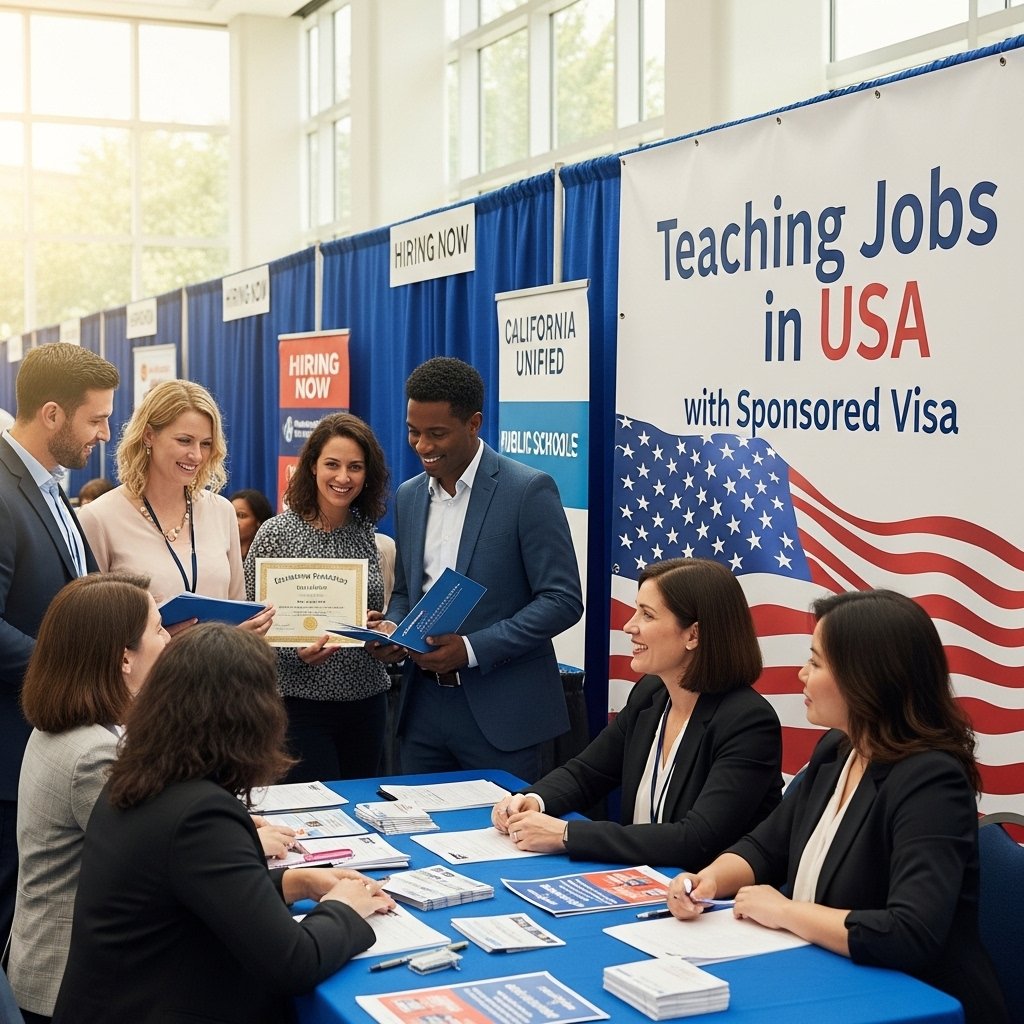
If you’ve ever dreamed of building a rewarding teaching career in the United States while having your visa sponsored by your employer, you’re not alone. Thousands of international educators make this transition every year, and the opportunities are more accessible than many people realize. Whether you’re a seasoned teacher from the Philippines, Nigeria, India, the UK, or anywhere else in the world, the U.S. education system is actively recruiting qualified foreign teachers — and many school districts are willing to foot the bill for your visa sponsorship.
In this comprehensive guide, we break down everything you need to know about teaching jobs in the USA with sponsored visas, including how much you can realistically earn, which states are hiring, what visa types apply, and how to land your first American teaching position.
Why the USA Needs International Teachers
The United States is currently experiencing one of the most significant teacher shortages in its modern history. According to data from the Learning Policy Institute, the teacher shortage has been growing steadily over the past decade, with certain subjects and geographic areas hit hardest. States like Texas, California, Florida, Arizona, and Nevada report chronic shortages in math, science, special education, and bilingual education.
This shortage has created an enormous window of opportunity for international educators. School districts, private institutions, charter schools, and universities are now more motivated than ever to recruit qualified teachers from abroad and sponsor their visas as part of the hiring package.
This isn’t charity it’s strategic. International teachers often bring multilingual skills, diverse cultural perspectives, and strong academic credentials that enrich American classrooms.
Total Revenue Potential: What Can You Earn?
Let’s talk numbers, because this is what most prospective applicants want to know.
The average public school teacher in the United States earns between $45,000 and $85,000 per year, depending on the state, subject specialty, experience level, and school district. However, total compensation when you factor in benefits, housing allowances, relocation packages, and professional development stipends offered specifically to visa-sponsored international teachers — can push your total value package well above $90,000 annually.
Here’s a realistic revenue breakdown by state for internationally sponsored teachers:
California pays some of the highest teacher salaries in the country. Entry-level teachers in Los Angeles Unified School District start around $50,000, while experienced educators can earn upward of $95,000. With the cost-of-living differential, the effective total compensation with benefits reaches approximately $110,000–$120,000 in total value.
New York offers starting salaries of around $57,000 in New York City public schools, climbing to over $100,000 with seniority. NYC has historically been one of the most aggressive recruiters of international educators through programs like the New York City Teaching Fellows and partnerships with recruitment agencies.
Texas may have a lower base salary — averaging around $57,000 statewide — but the absence of state income tax significantly boosts take-home pay. Houston ISD and Dallas ISD are both known for sponsoring H-1B and J-1 visas for qualified international teachers.
Maryland and Virginia, situated near the nation’s capital, offer salaries ranging from $50,000 to $80,000 with strong public school funding and active international recruitment programs.
Florida offers salaries between $42,000 and $70,000, with districts like Miami-Dade County being particularly active in recruiting international bilingual teachers, especially those fluent in Spanish and Haitian Creole.
When you add benefits — health insurance (worth $8,000–$20,000 annually), pension contributions, relocation assistance, and visa processing fees paid by the employer — the total annual value of a sponsored teaching position in the USA can conservatively be placed between $60,000 and $130,000 depending on location and experience.
Visa Types Available for International Teachers
Understanding which visa applies to your situation is critical. Here are the main visa categories used for sponsored teaching positions in the USA.
The J-1 Exchange Visitor Visa is the most commonly used visa for international teachers. It’s designed specifically for cultural exchange programs and allows teachers to work in U.S. schools for up to three years, with the possibility of a two-year extension. Programs like the Department of State’s Exchange Visitor Program facilitate J-1 placements. Teachers on J-1 visas are typically matched with host schools through designated sponsor organizations.
The H-1B Specialty Occupation Visa is another popular route, particularly for teachers in STEM fields, special education, and bilingual education. The H-1B requires that the position qualifies as a specialty occupation and that the teacher holds at least a bachelor’s degree in a related field. School districts can file H-1B petitions on behalf of their international hires, and this visa can lead to permanent residency (Green Card) over time.
The O-1 Visa is available for teachers with extraordinary ability or achievement in education. It’s less common but applicable for highly accomplished educators, researchers, or those with significant academic publications or awards.
The TN Visa is exclusively available to Canadian and Mexican citizens under the United States-Mexico-Canada Agreement (USMCA). It allows teachers in eligible categories to work in the U.S. relatively quickly without going through the H-1B lottery process.
The EB-1, EB-2, and EB-3 Employment-Based Green Cards are the permanent residency pathways that many sponsored teachers eventually pursue after establishing themselves in U.S. school systems. Some school districts, particularly those with chronic shortages, will sponsor Green Cards directly for committed educators.
Which School Districts Actively Sponsor Visas?
Not every school district in the United States sponsors visas, but a significant and growing number do. Here are some of the most well-known and active ones.
Los Angeles Unified School District (LAUSD) in California is one of the largest school districts in the country and has a long history of international teacher recruitment. They actively seek bilingual teachers, math teachers, and special education specialists.
Houston Independent School District (HISD) in Texas has partnered with international recruitment agencies and the Texas Education Agency to bring in teachers from the Philippines, India, and other countries. They are known for offering relocation support and visa sponsorship.
New York City Department of Education runs one of the most comprehensive international teacher recruitment programs in the country. With over 1,800 schools serving more than 1 million students, NYCDOE regularly works with J-1 sponsors and has hired thousands of international teachers over the years.
Miami-Dade County Public Schools in Florida actively recruits Spanish-speaking teachers from Latin America and bilingual educators from the Caribbean.
Clark County School District in Nevada (which serves Las Vegas) has faced persistent teacher shortages and has turned to international recruitment to fill critical positions in math, science, and special education.
Chicago Public Schools in Illinois is another large urban district with international hiring initiatives, particularly for bilingual and ESL teachers.
Baltimore City Public Schools in Maryland and Prince George’s County Public Schools in Virginia are both known for sponsoring J-1 and H-1B visas for qualified international applicants.
Subjects in Highest Demand for International Teachers
While international teachers can find opportunities across various disciplines, certain subject areas see dramatically higher demand and, consequently, more aggressive visa sponsorship offers.
Mathematics at the secondary school level is perhaps the most in-demand teaching specialty across all 50 states. Teachers who can teach algebra, geometry, calculus, and statistics are being actively recruited internationally, particularly from India, the Philippines, and Eastern Europe.
Science, especially biology, chemistry, physics, and earth science, is similarly short-staffed nationwide. STEM teachers are prioritized for H-1B sponsorship because their roles squarely meet the “specialty occupation” definition.
Special Education is a field with a critical national shortage. Teachers certified in working with students who have learning disabilities, autism spectrum disorders, emotional disturbances, or physical challenges are desperately needed. Many special education positions come with enhanced compensation packages and strong visa sponsorship offers.
Bilingual Education and ESL (English as a Second Language) is another high-demand area, particularly in states with large immigrant populations like Texas, California, New York, and Florida. Speakers of Spanish, Mandarin, Haitian Creole, Vietnamese, Arabic, and other languages are highly sought after.
Computer Science and Technology teaching positions are growing rapidly as K-12 schools expand their technology curricula. Teachers with backgrounds in software, coding, or IT are attractive candidates for visa sponsorship.
Healthcare and Nursing Education at the postsecondary level is also experiencing shortages, with community colleges and vocational schools offering sponsored positions to qualified international instructors.
How to Qualify: Credentials and Requirements
To be eligible for a sponsored teaching job in the USA, you need to meet several requirements that can vary by state and school district.
Most states require that international teachers obtain state teaching licensure or certification. This usually involves having your foreign academic credentials evaluated by an approved agency such as World Education Services (WES), having your transcripts reviewed, potentially passing subject area exams like the Praxis, and completing any additional coursework required by the state.
You’ll typically need a bachelor’s degree at minimum, though many positions particularly at the secondary and postsecondary levels prefer or require a master’s degree. Your degree should be in the subject you intend to teach or in education.
English language proficiency is mandatory. If English is not your first language, you may need to demonstrate proficiency through standardized tests like TOEFL or IELTS, though many school districts waive this requirement for teachers from countries where English is the medium of instruction.
Background checks, health screenings, and fingerprinting are standard requirements for all teachers in U.S. schools, regardless of visa status.
Teaching experience in your home country is a significant asset and is often used to place you on the appropriate salary scale within a district’s pay structure.
How to Find Teaching Jobs in USA with Sponsored Visa
Finding legitimate sponsored teaching positions requires a multi-pronged approach. Here’s where to look and how to approach your search effectively.
International Teacher Recruitment Agencies are your first and most powerful resource. Agencies like Teachaway, Teacher Horizon, International Schools Services (ISS), and Search Associates specialize in connecting international teachers with U.S. schools and handling much of the visa paperwork. They work with school districts that have already committed to visa sponsorship, which removes much of the uncertainty from your search.
The U.S. Department of State’s Exchange Visitor Program maintains a list of designated J-1 sponsor organizations. These organizations — which include companies like Cultural Vistas, WorldTeach, and ASPECT — partner with school districts and facilitate the J-1 visa process. Browsing their listed programs gives you a direct pathway to sponsored positions.
State Department of Education Websites often list teacher shortages by subject area and sometimes maintain international recruitment portals. Texas, California, and New York, for example, have dedicated pages for internationally trained teachers walking through the certification and hiring process.
LinkedIn and Indeed are increasingly useful for finding sponsored teaching positions. Search using terms like “H-1B sponsored teacher,” “visa sponsorship teacher,” “J-1 teacher exchange,” or “international teacher recruitment” along with your subject area and preferred state.
Job Fairs for international educators, including virtual fairs run by organizations like Carney, Sandoe & Associates and TIEonline, connect candidates directly with hiring administrators from U.S. schools actively seeking international talent.
Direct Applications to large urban school districts are also effective. Districts like NYCDOE, LAUSD, HISD, and Miami-Dade all have international recruitment pages on their websites where you can apply directly and be evaluated for visa sponsorship eligibility.
The Application Process: Step by Step
Getting from application to arrival in the U.S. classroom involves a clear sequence of steps, and knowing the timeline helps you plan effectively.
The first step is credential evaluation. Submit your foreign transcripts and degrees to an approved evaluation service. This process typically takes 4 to 8 weeks and results in a report that U.S. institutions can use to assess your qualifications.
Next, research state certification requirements for the state where you want to teach. Each state has its own licensure board, its own testing requirements, and its own process for internationally trained teachers. Some states, like Texas, have streamlined processes specifically for internationally trained educators.
Once you understand what certifications you need, begin the application process with school districts or recruitment agencies simultaneously. Don’t wait until you have full certification in hand — many districts will hire provisionally while you complete remaining certification requirements.
After receiving a conditional or formal offer of employment, the visa sponsorship process begins. For J-1 visas, your host school’s designated sponsor organization will file the necessary paperwork with the Department of State. For H-1B visas, the school district’s legal team or an immigration attorney will file a petition with USCIS. This process can take anywhere from 3 to 8 months depending on the visa type and processing times.
Once approved, you’ll attend a visa interview at the nearest U.S. Embassy or Consulate, receive your visa stamp, and arrange your travel and relocation. Most school districts that sponsor teachers will assist with or fully cover relocation costs.
Life as an International Teacher in the USA
Beyond the paperwork and logistics, it’s worth painting a realistic picture of what daily life looks like once you’re established as an international teacher in the United States.
Most international teachers report a significant adjustment period during the first year. American classrooms can be more dynamic and student-centered than what many international educators are accustomed to, and classroom management styles may differ from those in your home country. Schools typically offer mentorship programs and professional development to help new teachers adapt.
The financial rewards are substantial relative to teaching salaries in most other countries. Even a mid-range U.S. teaching salary affords a comfortable lifestyle, the ability to save, and the opportunity to send remittances home. Many international teachers report being able to save $1,000 to $2,500 per month after covering living expenses, depending on the city.
Socially, most international teachers build strong community ties within their school, through cultural associations in their city, and through networks of fellow expats and immigrants. Cities with large international communities — New York, Houston, Los Angeles, Chicago, Miami — make the cultural transition significantly easier.
Professional growth opportunities are plentiful. American school districts invest heavily in professional development, and many offer tuition assistance for teachers pursuing advanced degrees. This means you can continue growing your credentials while earning a full salary and benefits.
Common Mistakes to Avoid
Many international teachers make avoidable mistakes that delay or derail their U.S. teaching careers. Here are the most important ones to be aware of.
Applying to schools or agencies without confirming they are legitimate is a serious risk. There are fraudulent agencies that promise visa sponsorship in exchange for large upfront fees. Legitimate sponsors and employers will never ask you to pay for your own visa petition filing. Always verify organizations through the Department of State’s official sponsor list or by checking with your country’s embassy.
Neglecting the state certification process is another common error. Many teachers assume that a teaching degree from abroad automatically qualifies them to teach in the U.S. It doesn’t. Each state has specific requirements, and starting the certification process early ideally before you receive a job offer — will save you significant time.
Underestimating the importance of subject-area testing is also common. Most states require teachers to pass Praxis exams or state-specific tests. Preparing thoroughly for these assessments is critical, particularly for non-native English speakers who may need additional preparation time.
Ignoring the cultural and pedagogical differences between your home country and U.S. schools can lead to early frustration. American students, on average, expect a more interactive and discussion-based learning environment. Coming prepared to adapt your teaching style will make your first year much smoother.
Paths to Permanent Residency and Citizenship
For many international teachers, the ultimate goal is not just a temporary work visa but permanent residency and eventually U.S. citizenship. Teaching is one of the professions that offers a relatively clear pathway.
After working on a J-1 visa, teachers who demonstrate exceptional performance and commitment can be sponsored by their school district for an H-1B visa, which then becomes a stepping stone toward a Green Card through the EB-3 or EB-2 employment-based categories.
Teachers who work in designated shortage areas or with underserved populations may qualify for National Interest Waiver (NIW) petitions, which allow certain professionals to bypass the labor certification requirement for Green Cards.
Long-term teachers who obtain permanent residency and eventually citizenship can sponsor family members, access federal loans for further education, and enjoy full employment rights across any profession they choose.
Top Countries Whose Teachers Are Most Recruited by U.S. Schools
While U.S. schools recruit internationally from dozens of countries, certain nationalities are particularly well-represented in American classrooms due to English proficiency, educational system similarities, and active bilateral recruitment agreements.
The Philippines consistently tops the list, with thousands of Filipino teachers working across the United States on J-1 and H-1B visas. Filipino teachers are particularly valued for their English fluency, strong academic preparation, and cultural adaptability.
India sends large numbers of math and science teachers annually, many of whom enter through the H-1B pathway due to their technical qualifications.
Jamaica, Trinidad and Tobago, and other Caribbean nations contribute a significant number of English-speaking teachers, particularly to schools in New York, Florida, and Maryland.
Nigeria, Ghana, and South Africa are growing sources of internationally recruited teachers, particularly in math, science, and special education.
The United Kingdom and Australia also contribute teachers, particularly to private and international schools, though their visa pathways sometimes differ from those of non-English-speaking countries.
FAQs: Teaching Jobs in USA with Sponsored Visa
Q: Can I get a teaching job in the USA without a U.S. teaching certificate? A: In many cases, yes — provisionally. Many school districts will hire international teachers under a provisional or emergency certification while they complete the requirements for full state licensure. However, you will need to work toward obtaining proper certification within a specified period, usually one to three years.
Q: How long does the visa sponsorship process take? A: It depends on the visa type. J-1 visas typically process within 2 to 4 months once a sponsor organization is confirmed. H-1B visa petitions can take 3 to 6 months under regular processing, though premium processing (available for an additional fee) can reduce this to 2 to 3 weeks. Plan for a timeline of at least 6 months from job offer to visa approval.
Q: Do I have to pay for my own visa if a school sponsors me? A: Legitimate school districts and sponsor organizations cover most or all of the costs associated with sponsoring your visa. Be extremely cautious of any entity that asks you to pay large upfront fees. While some small administrative costs may be shared, the bulk of petition and sponsorship fees should be borne by the employer.
Q: Which states are easiest for international teachers to get certified? A: States with high teacher shortage rates and streamlined processes for international educators include Texas, Florida, Nevada, and Arizona. Some states like California have more rigorous requirements but also offer more competitive salaries and stronger job protections.
Q: Can I bring my family with me on a sponsored teaching visa? A: Yes. Both J-1 and H-1B visas allow dependent family members to accompany the primary visa holder. Spouses and children can enter on J-2 or H-4 dependent visas. J-2 dependents are generally eligible to apply for work authorization, which is a significant benefit for families where both spouses want to work.
Q: Is the J-1 visa the best option for international teachers? A: The J-1 is the most commonly used visa for international teachers because it was specifically designed for educational and cultural exchange. However, the H-1B may be a better long-term option if your goal is to remain in the U.S. permanently, as it is a dual-intent visa that allows you to pursue a Green Card while on it — something the J-1 generally does not permit without a waiver.
Q: What happens if my visa-sponsored job doesn’t work out? A: If your employment ends while on a visa, you generally have a grace period — 60 days for H-1B holders — to find a new employer who can transfer your visa sponsorship, change to a different visa status, or depart the country. It’s important to address this quickly and work with an immigration attorney if your employment situation changes unexpectedly.
Q: Are there teaching opportunities in private schools or universities for international educators? A: Absolutely. Private K-12 schools, charter schools, community colleges, and universities all hire international educators and can sponsor visas. Universities in particular often use H-1B or O-1 visas for faculty positions. Private schools may use J-1 or H-1B depending on their size and legal resources.
Q: How much can I realistically save as a sponsored international teacher in the USA? A: This depends heavily on your location and lifestyle. In a lower cost-of-living city like Houston or Phoenix, a teacher earning $55,000 can reasonably save $15,000 to $25,000 per year after expenses. In New York City, despite higher salaries, the cost of living means your savings rate may be similar or lower unless you manage expenses carefully.
Q: What is the best recruitment agency for finding sponsored teaching jobs in the USA? A: Some of the most reputable agencies include Teachaway, Teacher Horizon, and International Schools Services (ISS). For J-1 programs specifically, organizations like ASPECT Foundation and Cultural Vistas are well-established. Always verify any agency’s credentials and read reviews from other international teachers before committing.
Teaching in the United States as an international educator is one of the most professionally rewarding and financially significant career moves you can make. With a genuine shortage of qualified teachers across the country, sponsored visa programs have never been more accessible. The total earnings potential when you account for salary, benefits, and the long-term path to permanent residency represents a life-changing opportunity for dedicated educators worldwide.
Start your credential evaluation today, research the state that fits your goals, connect with a reputable recruitment agency, and take the first step toward a teaching career in America.